
AI IMAGE GENERATION IS NOT EASY. IT’S CONTROL.
There’s a misconception that AI image generation is quick.
Type a prompt.
Press generate.
Get something great.
That’s not how this works. Not if you care about precision.
What people see is the final image.
What they don’t see is everything it takes to get there.
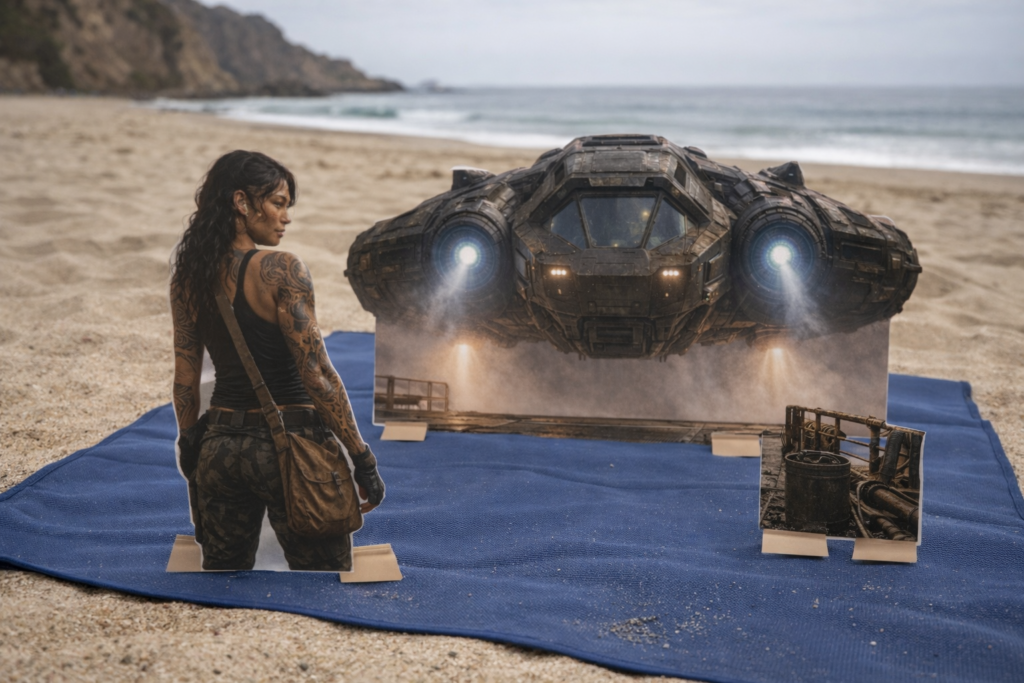
You’re Not Generating Images. You’re Directing Them
The moment you want consistency, realism and intention, AI stops being a toy and starts behaving like an unpredictable production team.
It doesn’t understand blocking.
It doesn’t understand lenses.
It doesn’t understand spatial logic.
So you have to build all of that for it.
That’s where the process begins.
Why Cardboard and Miniatures Exist
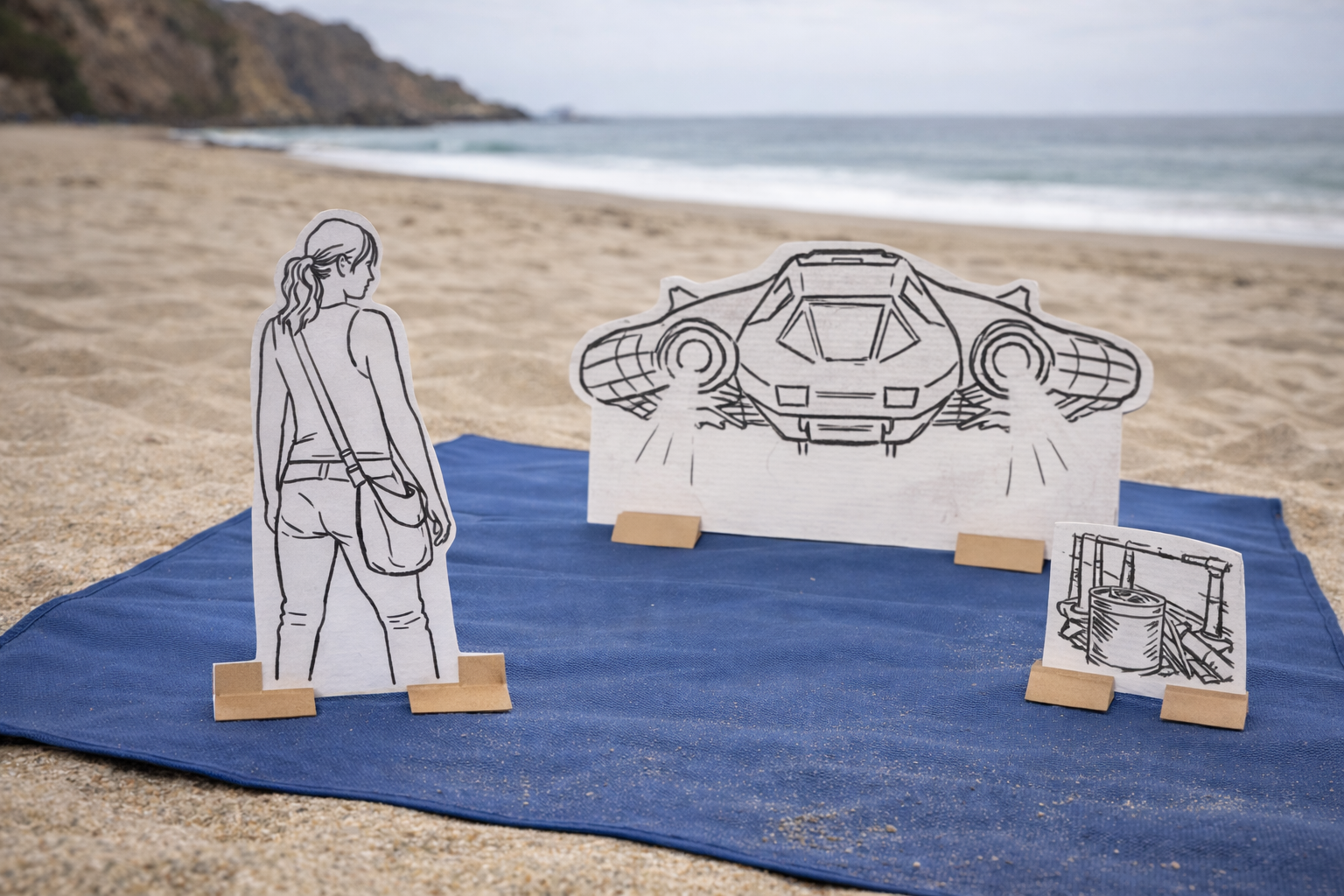
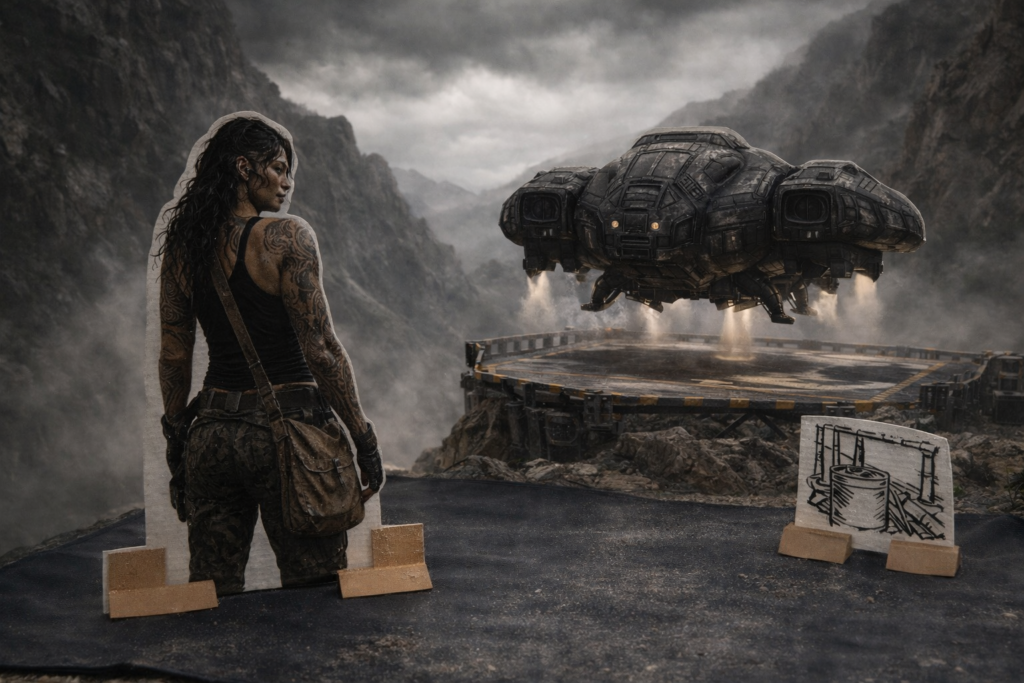
Before anything becomes photorealistic, it starts as something much simpler.
Cardboard cutouts.
Rough sketches.
Miniature stand-ins.
Physical placeholders.
Not because it looks good, but because it gives you control.
You are essentially building a scene the AI can’t misinterpret.
You lock:
• Camera position
• Angle
• Framing
• Subject placement
• Depth
• Spacing
Once that’s fixed, it becomes the foundation.
Without that, the AI drifts. Every single time.
Composition Is Everything
The biggest mistake with AI is allowing it to “decide” composition.
That’s where everything breaks.
A character shifts slightly.
The depth changes.
The perspective flattens.
The scale becomes inconsistent.
So the rule becomes absolute:
Nothing moves.
You are not asking the AI to create a scene.
You are forcing it to rebuild a scene that already exists.
That’s a completely different task.
The Hidden Work No One Talks About
Getting the composition right is just the beginning.
Then comes everything else you have to control manually:
Depth of Field
You’re not just asking for blur. You’re deciding what the lens is doing. What’s in focus. What falls away. How far the environment stretches.
Lighting
Where is the light coming from?
Is it natural or artificial?
Is it diffused or harsh?
Does it match the environment and the time of day?
If lighting isn’t consistent, the entire image breaks instantly.
Point of View
Is the camera at eye level?
Low angle?
Over-the-shoulder?
Is it observing or part of the scene?
AI will happily change this unless you lock it.
Scale and Weight
Does the character feel like they exist in the world?
Are they grounded?
Do they have mass?
AI often produces things that look correct, but feel wrong.
That’s usually a scale problem.
Pose and Intention
A character isn’t just standing there.
They are:
• Facing something
• Reacting to something
• Holding tension
• Carrying intent
If that’s not defined, you get lifeless results.
Eye-line
Where someone is looking changes the entire scene.
One wrong eye-line and the narrative collapses.
Material Behaviour
Metal reflects differently to fabric.
Wet surfaces behave differently to dry ones.
Dust, fog, rain all interact with light differently.
If these aren’t aligned, the realism disappears.
Why the Prompt Becomes So Precise
This is why the prompt ends up looking like a technical document.
Because it has to be.
You’re not describing an image.
You’re rebuilding physics, space and behaviour inside a fixed frame.
You are telling the AI:
Do not move anything.
Do not interpret anything.
Do not improve anything.
Just replace what’s there with reality.
That’s the job.
The Frustration
Even with all of this in place, it still goes wrong.
The face changes.
The pose shifts.
The lighting breaks.
The environment feels artificial.
And the worst part is this:
You can fix one thing and break three others.
So the process becomes repetition.
Refine.
Generate.
Check.
Adjust.
Repeat.
Again and again until something finally holds together.
Why It’s Worth It
Because when it works, it works properly.
The image feels grounded.
The scene feels intentional.
The characters feel like they exist in that space.
Not generated. Directed.
And that’s the difference.
What This Actually Is
This isn’t “AI art”.
It’s scene construction.
It’s directing without a camera.
It’s staging without actors.
It’s building something precise using a tool that constantly tries to generalise.
That’s the challenge.
And that’s why it takes time.
The Reality
AI doesn’t remove the work.
It shifts it.
From physical production
to mental precision.
From equipment
to control.
From execution
to direction.
And if you want something that actually holds up visually, there’s no shortcut.
Just process.
Control.
And a lot of patience.